
Timber & Tracks: A Match made in Almost Heaven
Few states are as deeply shaped by their railroads as West Virginia. From the moment Henry Gassaway Davis drove his West Virginia Central & Pittsburgh Railway into the Allegheny Highlands in the 1880s, rail lines became the arteries through which the state’s vast timber and coal wealth flowed to the wider world. Many of our Mon Forest Towns, like Elkins, Durbin, and Thomas, exist because of the iron horse, carved from dangerous wilderness by crews who laid track along riverbeds and over mountain passes that roads wouldn’t reach for decades afterward.
Today, that same rugged terrain that once made railroads essential now makes them unforgettable. With some of the most dramatic mountain scenery east of the Rockies, West Virginia has become one of the country’s top destinations for scenic train rides, sightseeing trips, and heritage rail experiences. Whether you’re a dedicated rail-fan or a family looking for something beyond the ordinary, the state’s scenic railroads offer a way to see the Appalachian landscape the way it was meant to be seen.

Planning Your WV Scenic Railroad Adventure
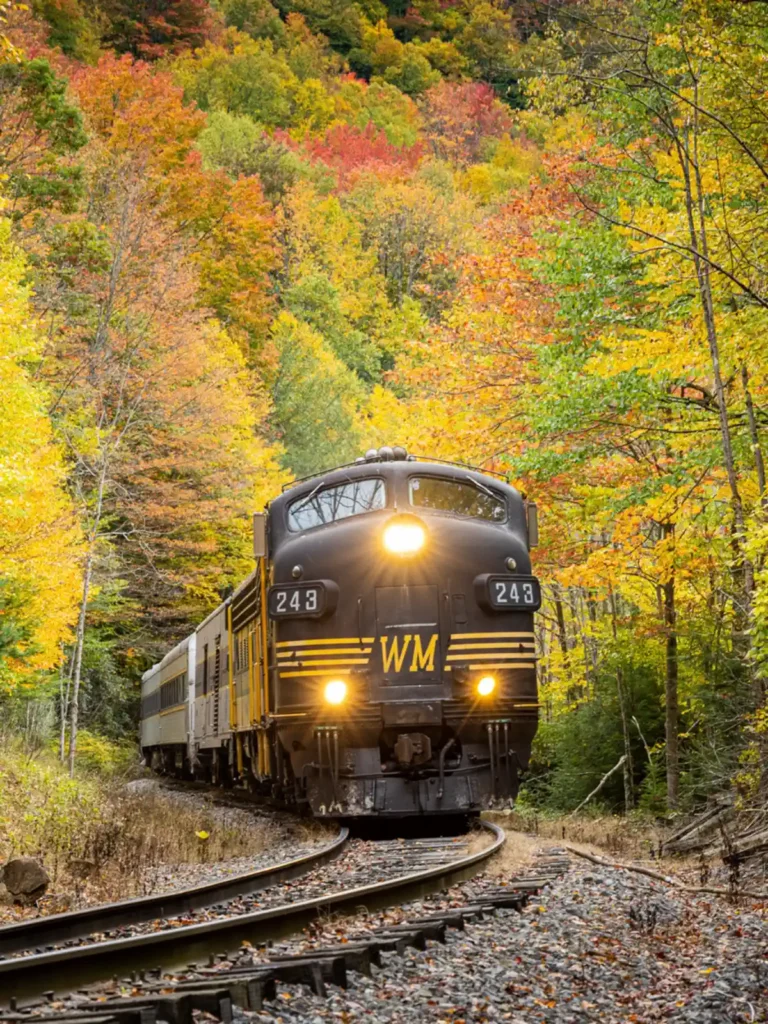
West Virginia’s scenic railroads are ideal as standalone day trips or as part of a longer exploration of the Monongahela National Forest region. The Cass Scenic Railroad and New Tygart Flyer are both operated by the Durbin & Greenbrier Valley Railroad and are a little over an hour apart by car, making it easy to combine both into a multi-day train vacation. The Potomac Eagle is located in the state’s eastern panhandle, roughly two hours east, and pairs well with a visit to the Potomac Highlands.
For the most dramatic scenery, fall is hard to beat. The mountains surrounding all three railroads put on a spectacular display of color from late September through mid-October, and all three railroads offer enhanced fall foliage schedules. But each season has its own appeal: spring brings wildflowers and returning wildlife, summer offers the fullest canopy and longest days, and winter excursions provide a storybook holiday adventure.
For more information and reservations, visit Mountain Rail WV for Cass Scenic Railroad and New Tygart Flyer excursions, or Potomac Eagle Scenic Railroad for the Romney-based excursions.
West Virginia Scenic Railroads Guide
Cass Scenic Railroad
Cass, West Virginia
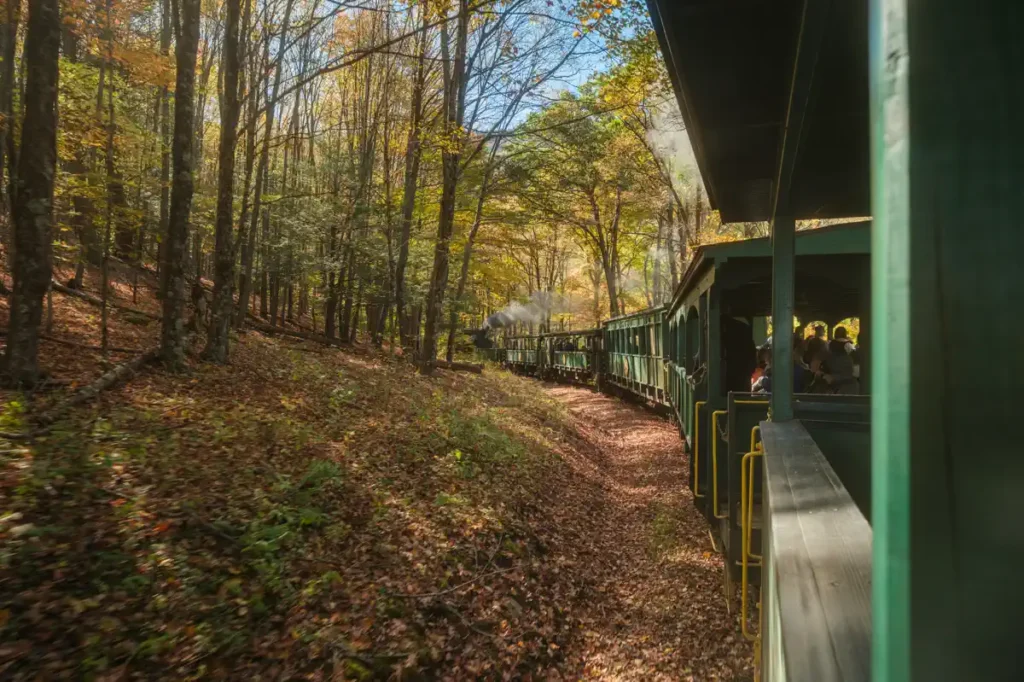
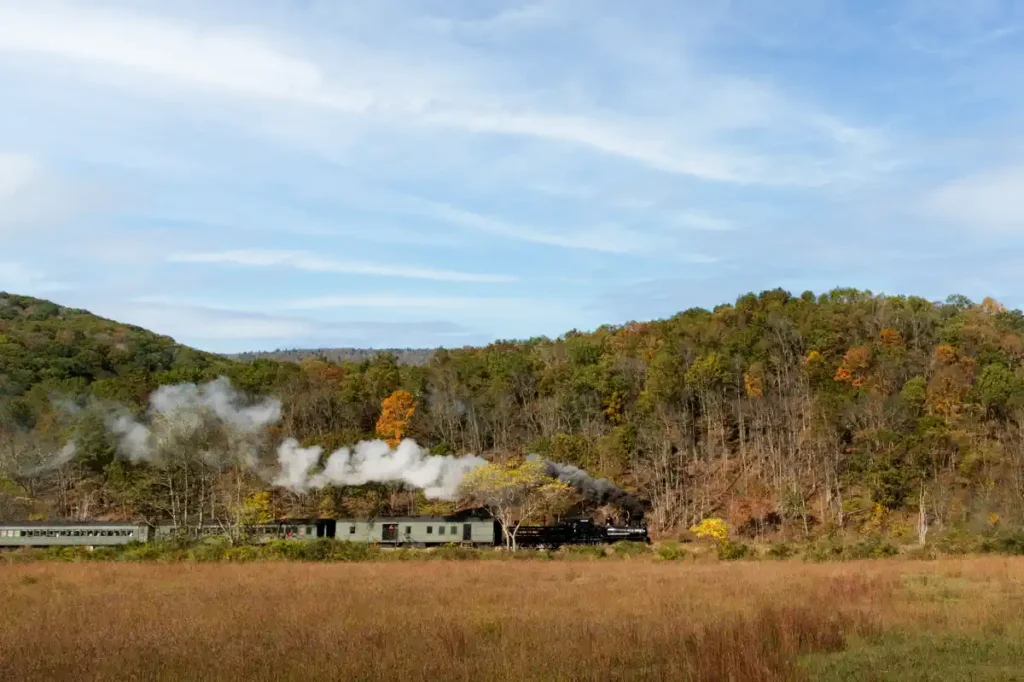
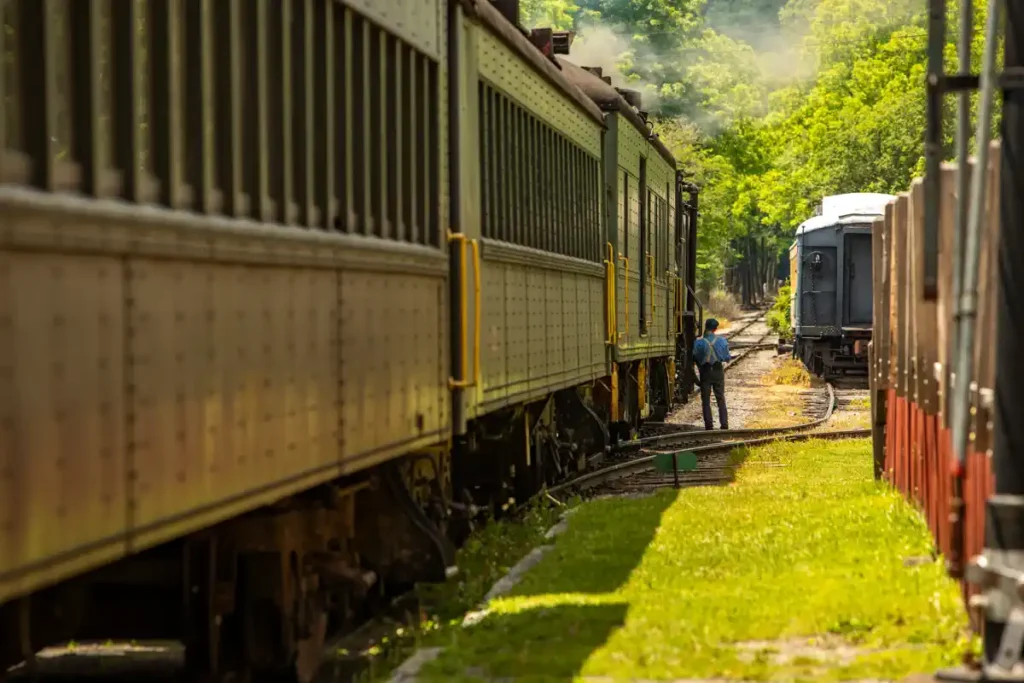
Images courtesy of Pocahontas County CVB & Mon Forest Towns
Valleys & Summits
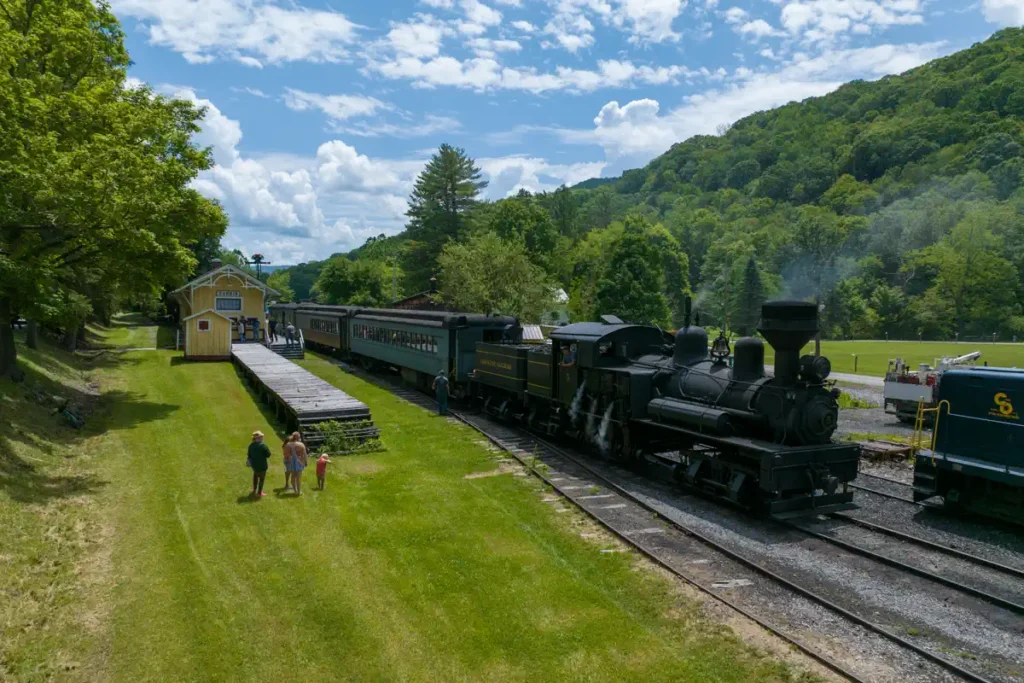
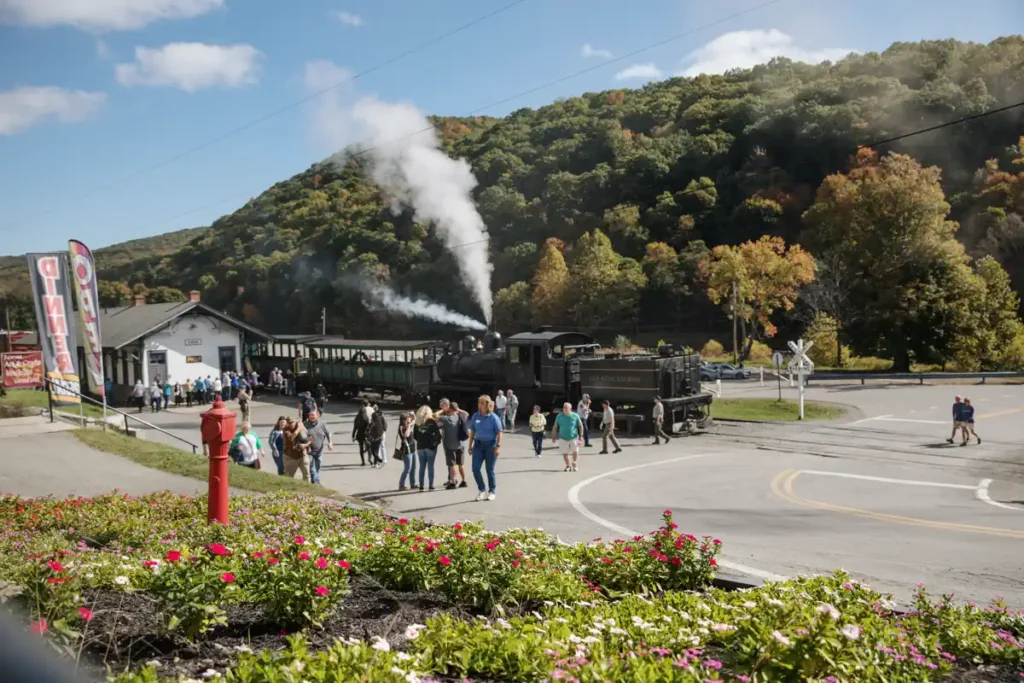
The Cass Scenic Railroad departs from the small, remarkably well-preserved company town of Cass, tucked into a narrow valley along the Greenbrier River in Pocahontas County. Deep in the Appalachian highlands, far from cell service and city lights, the elevation starts at 2,400 feet and only goes up. From the moment the train lurches forward with the unmistakable chugging of a steam-powered Shay locomotive, passengers begin climbing into a world that feels far removed from the modern era.
The Bald Knob route ascends 2,390 vertical feet over 11 miles, switchbacking up the flank of the Monongahela National Forest’s Back Allegheny Mountain through thick forests of red spruce and northern hardwoods. At these elevations, the forest takes on a boreal character, with spruce stands, mossy boulders, and fern-covered understory reminiscent of northern Canada rather than the mid-Atlantic. The air cools noticeably as the train climbs, so don’t forget to bring a coat! Wildflowers dot the meadows at Whittaker Station, and at the summit of Bald Knob, which sits at an elevation of 4,842 feet, the third-highest point in West Virginia (after Spruce Knob and Snowshoe’s Thorny Flat), a sweeping panoramic overlook reveals an unbroken sea of ridgelines stretching into Virginia and beyond.
The Greenbrier Express route offers an entirely different experience, following the free-flowing Greenbrier River northward for 15 miles through the secluded corners of the Mon. Forested mountains rise at every bend of the river, and wildlife sightings, including deer, river otters, black bear, bald eagles, ospreys, and hawks, are common along this remote stretch.
Cass Excursion Options
Cass offers several distinct excursions during its regular season, which runs from May through October:
- Bald Knob — The flagship experience. This 4.5-hour, 22-mile round trip climbs to the summit overlook via switchbacks and grades exceeding nine percent. A stop at Whittaker Station, featuring an authentically recreated logging camp, breaks up the ascent. A cold-cut lunch is included.
- Whittaker Station — A shorter, 2-hour, 8-mile round trip up the lower slopes of Cheat Mountain along scenic Leatherbark Creek. This route is especially popular with families and those short on time.
- Greenbrier Express — A 5.5-hour river-grade journey from Cass to the mountain town of Durbin, following the restored Chesapeake & Ohio Greenbrier Division. Lunch is included and served in Durbin at the historic depot or a Main Street restaurant.
Specialty and seasonal events include Christmas at Cass, a steam-powered holiday excursion along the Greenbrier River featuring decorated and heated coaches, visits from Santa, children’s gifts, and thousands of lights illuminating the historic town. If you missed the festive foray, the Winter Greenbrier Express offers weekend departures from January to February. The Ghost Town excursion offers a rare look at the abandoned lumber settlement of Spruce, deep in the Monongahela National Forest. Other special events include the Steam Parade (a unique festival of operable steam locomotives), Durbin’s Wild West Weekend, the Titans of Logging Photography Weekend, and the rare Geared Titans excursion featuring Shay, Heisler, and Climax geared locomotives running in tandem.
While Cass Scenic Railroad’s Bald Knob and Whittaker Station excursions are handicap-accessible, please note that, due to their historic nature, the Greenbrier Express and Christmas excursions are not ADA-compliant.
Paper & Pulp Railroad History
The Cass Scenic Railroad is not a recreation of history; it is history, still running on the same rails and behind the same type of locomotives that built it. The line was constructed in 1901 by the West Virginia Pulp & Paper Company (WVP&P) to haul timber from the vast virgin spruce forests of Cheat Mountain down to the mill at Cass. The locomotives are original Shay geared engines, built by Lima Locomotive Works, specifically designed for the steep, winding grades of mountain logging operations. The open passenger cars are converted logging flatcars.
At its peak, the operation shipped over one billion board feet of lumber from these mountains, timber that helped fuel the nation’s growth but also fundamentally transformed the Appalachian highland landscape. Much of the land logged by these operations was acquired by the Monongahela National Forest, established in 1920. Today, the forests the train passes through are second- and third-growth timber, a living testament to the regenerative power of these mountains.
When the lumber era ended, the railroad nearly went to scrap in the 1960s. The State of West Virginia intervened, preserving the operation as Cass Scenic Railroad State Park. In 2014, the Durbin & Greenbrier Valley Railroad leased the operation and invested millions in restoring the former C&O Greenbrier Division between Cass and Durbin, a line that had been abandoned since the 1970s.
New Tygart Flyer
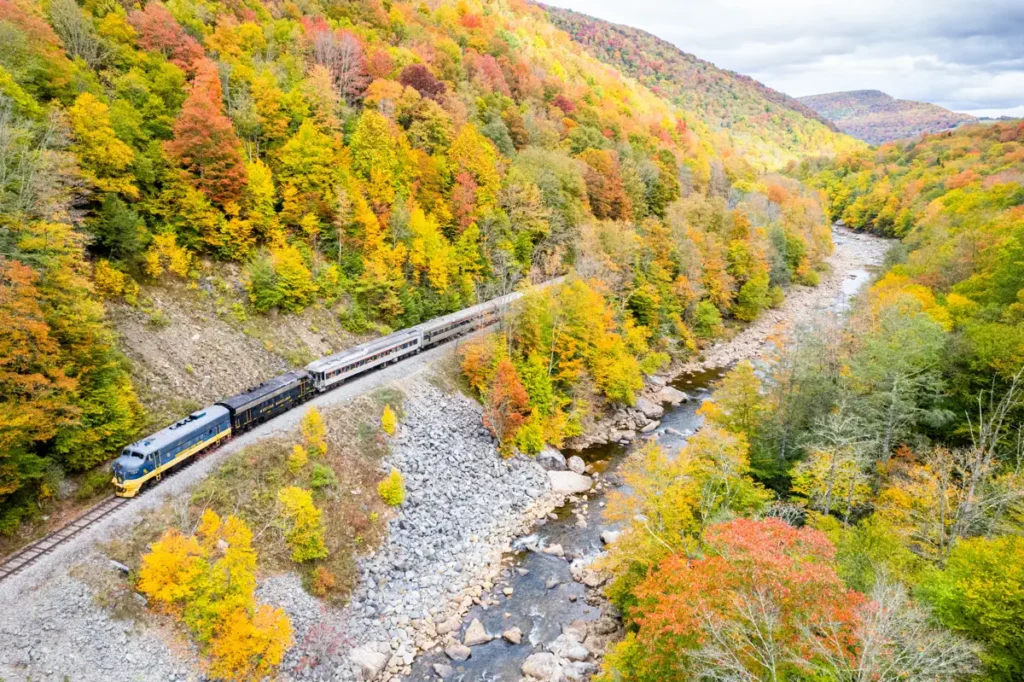
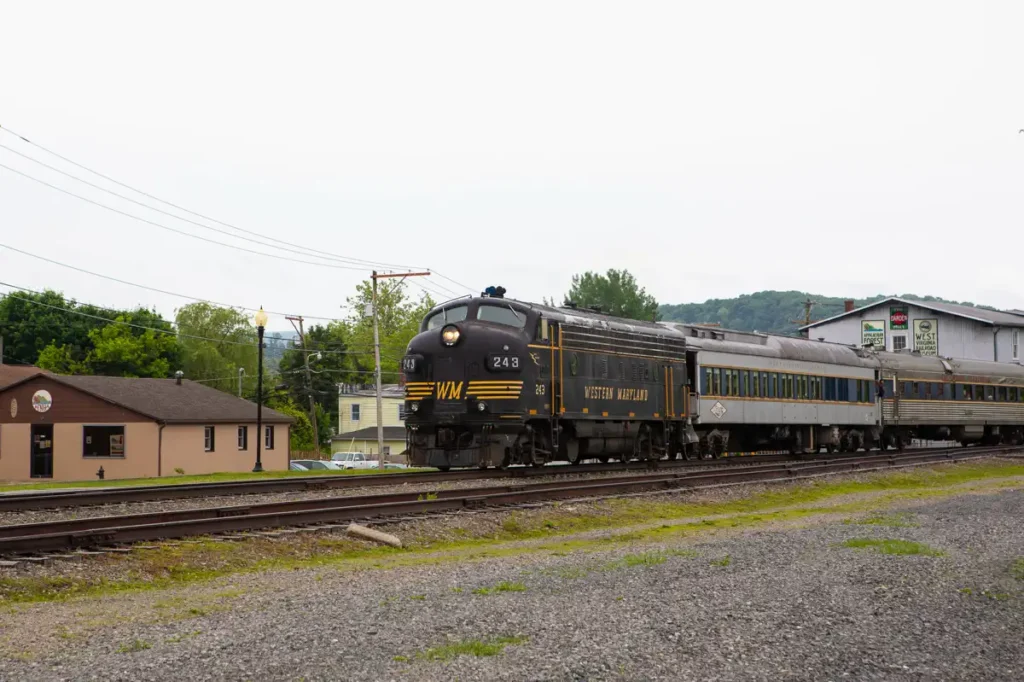
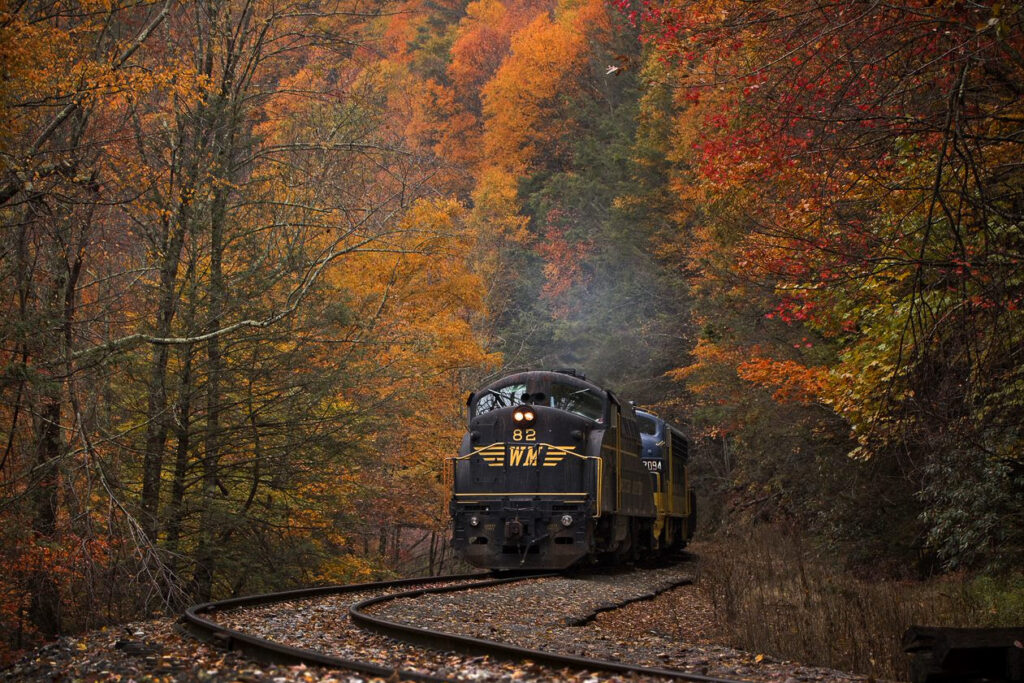
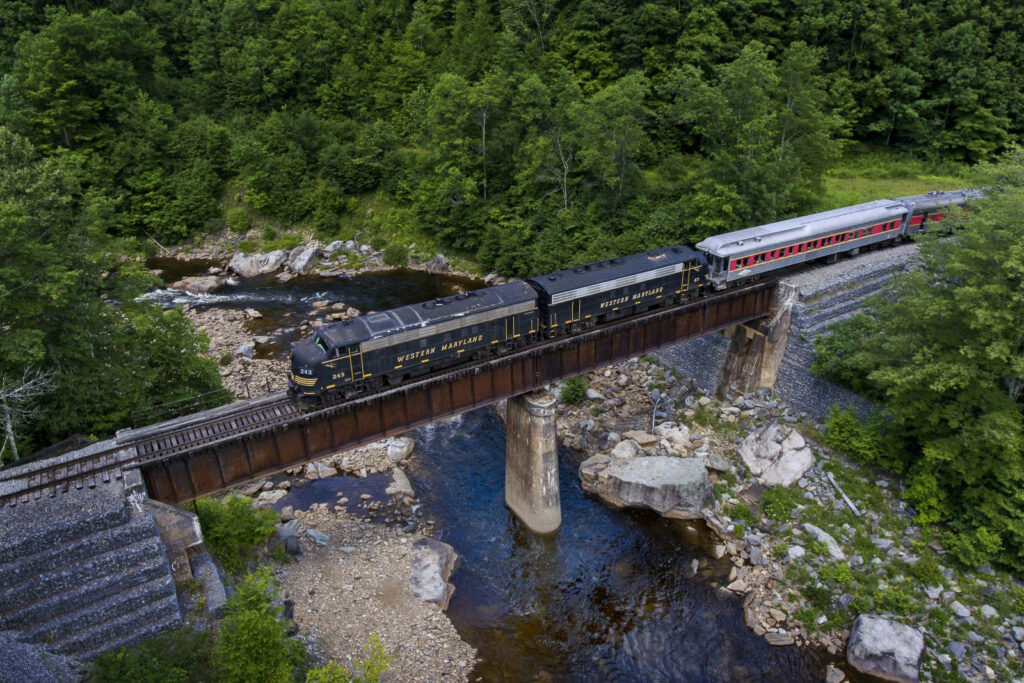
Images courtesy of Elkins-Randolph County CVB & Mon Forest Towns
Waterfalls & Wilderness
The New Tygart Flyer departs from the beautifully restored Western Maryland Railroad depot on Railroad Avenue in downtown Elkins, a historic railroad hub at the heart of the Monongahela National Forest region. This is one of the most immersive train excursions in the eastern United States, with a 4-hour, 46-mile round trip that takes passengers deep into a landscape no highway can reach.
From the Elkins depot, the vintage diesel-powered train heads south, climbing along the Shavers Fork of the Cheat River as the Tygart Valley falls away behind. The route features two distinct mountain grades and passes through an “S”-curve tunnel bored through solid rock, a relic of the engineering ambition that built these mountain railroads over a century ago. As the train gains elevation, the terrain grows increasingly rugged. The Shavers Fork cascades alongside the tracks, tumbling over boulders through a corridor of towering hardwoods and hemlocks. The canyon deepens to 1,500 feet, with steep, densely forested slopes rising sharply on both sides.
The climactic moment comes at the High Falls of Cheat, a 150-foot-wide waterfall set in one of the most remote and pristine locations in the eastern United States. The closest road is five miles away; the falls are accessible only by train or on foot. The train pauses here, allowing passengers to take in the sight and sound of the falls echoing through the canyon.
Elkins Excursion Options
The New Tygart Flyer operates from April through November, with the core experience being:
- New Tygart Flyer — A 4-hour, 46-mile round trip departing at 11 a.m. from the Elkins depot. Climate-controlled vintage passenger coaches. A cold-cut lunch with chips, a cookie, and water is included and served onboard. Coffee, tea, and water are also provided. Restrooms are available on the train.
- Parlor Car Upgrade — For those seeking a more refined experience, the Parlor Car offers comfortable seating at private tables, an expanded buffet, adult beverages, and a dedicated car host. Passengers aged 12 and under are not permitted in the Parlor Car.
The Durbin & Greenbrier Valley Railroad, which operates the New Tygart Flyer, also runs several specialty excursions from the Elkins and Bellington depots:
- Murder Mystery Wine Train — An evening excursion following the same route to High Falls, pairing an interactive whodunit with heavy hors d’oeuvres from the Railyard Restaurant and wine tastings from Lambert’s Winery.
- Bellington Zephyr— In October, special extended excursions depart from Belington, travel through the Tygart River Gorge and Elkins, and continue along the Shavers Fork through the Monongahela National Forest at peak autumn color.
- Cottontail Express — A spring Easter-themed family ride from Elkins to Belington City Park with vendors, activities, and an Easter Bunny meet-and-greet.
- Ramp Festival Ride — A celebration of the wild Appalachian leek, with local food vendors, arts, crafts, live music, and short train trips.
- Winter Excursions — Special winter departures from Belington through the Tygart River Gorge offer a quieter, snow-dusted perspective on the landscape.
Please note that, due to its historic nature, the Tygart Flyer out of Elkins is not ADA-accessible.
Western Maryland Railroad History
The New Tygart Flyer operates over former Western Maryland (WM) Railway trackage, born from the ambitions of U.S. Senator Henry Gassaway Davis and his son-in-law, Stephen B. Elkins. Davis founded the West Virginia Central & Pittsburgh Railway (WVC&P) in 1866 to connect the vast coal and timber resources of the Allegheny Highlands to world markets. Construction began in 1880 and reached the new town of Elkins in 1889.
The city of Elkins quite literally owes its name and existence to the railroad. What had been a small farming community called Leadsville was transformed almost overnight into a booming commercial center and railroad hub. Western Maryland’s yard and depot became the center of operations for lines radiating north, south, and west to serve coal mines, tanneries, and the enormous timber operations that stripped the surrounding mountains of their virgin forest. Much of that logged-over land was later acquired by the federal government and became the Monongahela National Forest.
The New Tygart Flyer’s route follows the Shavers Fork directly through the heart of the Monongahela National Forest, passing through some of the same territory that was logged by the railroads a century ago. The forest that now surrounds the tracks, thick, tall, and teeming with wildlife, is the result of a century of regrowth and federal stewardship.
When CSX attempted to abandon the remaining Western Maryland lines around Elkins in the 1990s, the State of West Virginia intervened. The West Virginia Central Railroad was inaugurated in 1998, and the Durbin & Greenbrier Valley Railroad began operating passenger excursions over the preserved corridors. The Elkins depot, the same brick Romanesque Revival-styled Western Maryland depot built in 1908, now serves as Randolph County’s visitors center and the starting point for heritage rail experiences. The West Virginia Railroad Museum and Appalachian Discovery Center, housed in the old Darden Mill building in the adjacent rail yard, preserves the story of how railroads built this region.
Potomac Eagle Scenic Railroad
Romney, West Virginia
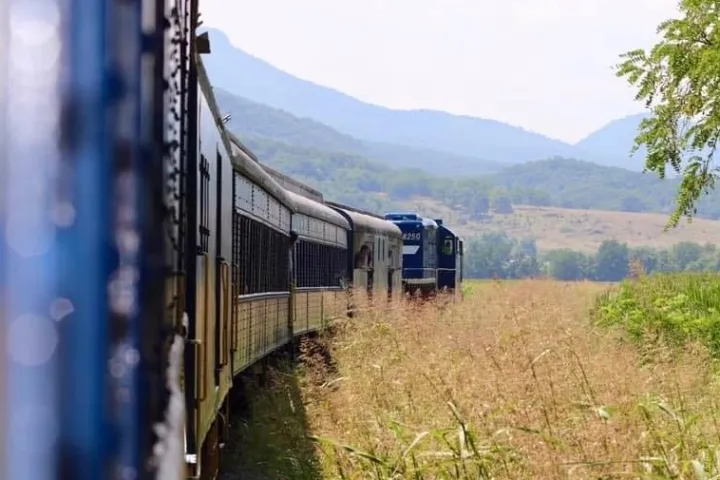
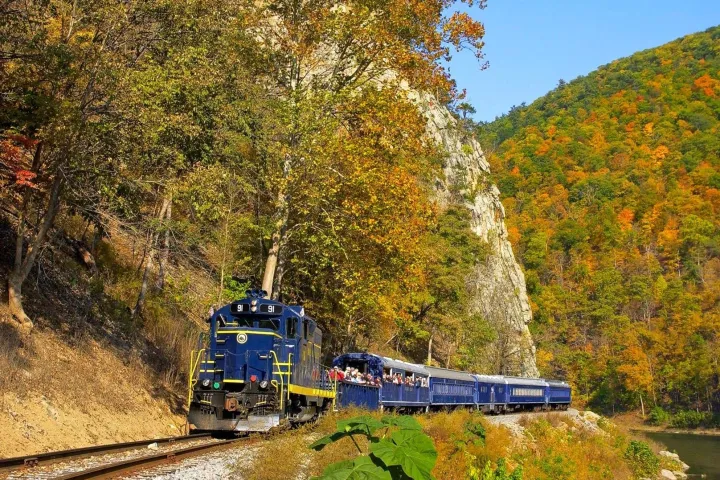
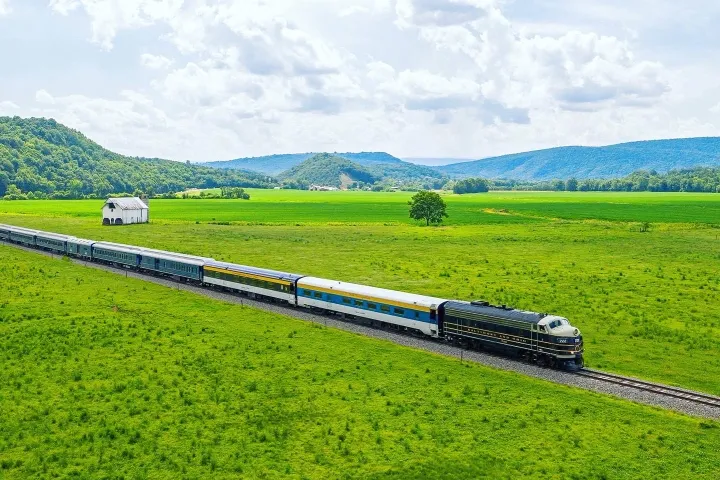
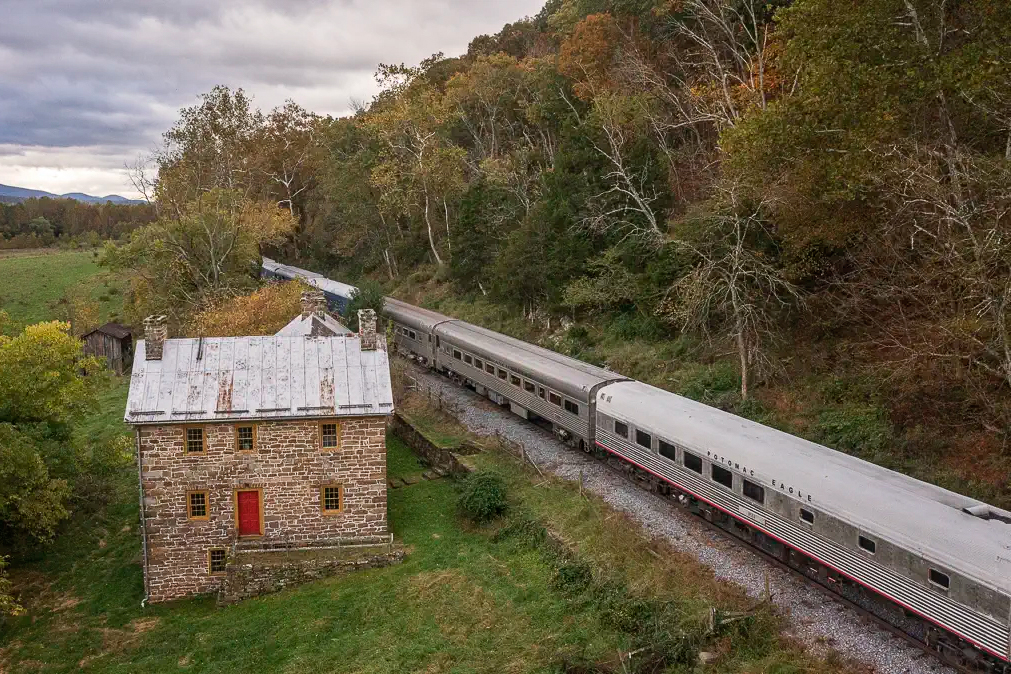
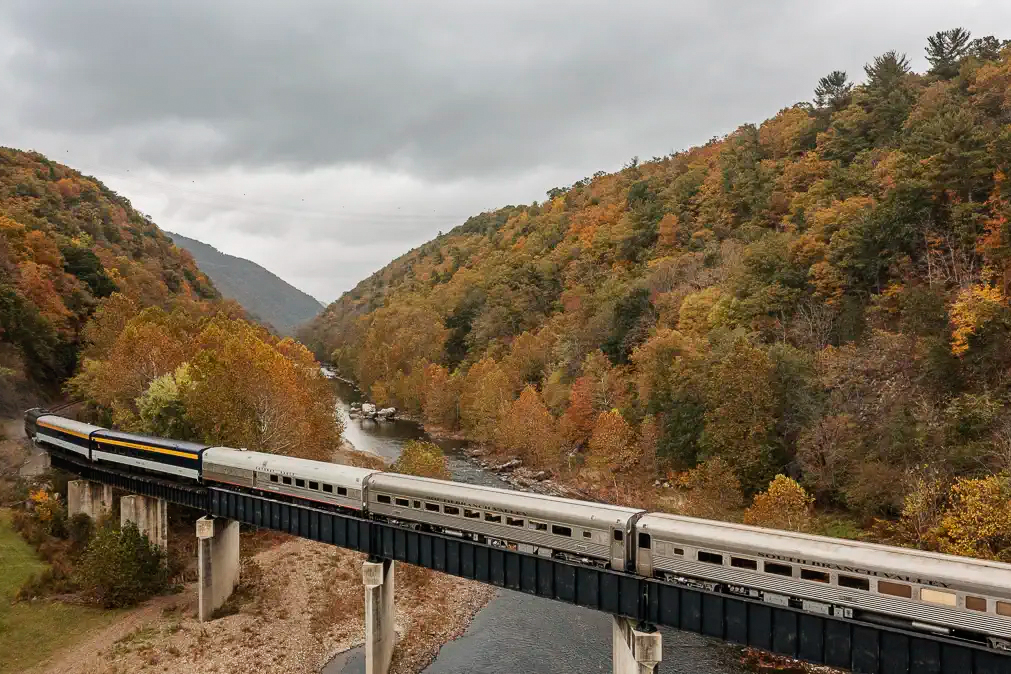
Images courtesy of Potomac Eagle Scenic Railroad & West Virginia Tourism
Canyons & Caverns
The Potomac Eagle Scenic Railroad departs from Wappocomo Station just outside Romney, the seat of Hampshire County and one of the oldest towns in West Virginia. The landscape here is markedly different from the high-elevation spruce forests of the Cass region. This is the Ridge and Valley Province of the eastern panhandle, where the South Branch of the Potomac River has carved its way through long parallel ridgelines of folded Appalachian rock.
Paired with knowledgeable narrators and excellent hospitality, riders begin their journey in the panhandle’s open pastoral country. As the vintage diesel locomotives pull the train southward from Wappocomo Station, passengers pass through rolling farmland and historic homesteads dating to the 1700s, with mountain ridges rising on either side. The character of the landscape shifts dramatically as the train enters the “Trough” a remote, narrow canyon where steep, densely forested slopes press close on both sides and the river narrows below a towering hardwood canopy. George Washington first described this canyon during a 1748 surveying expedition for Lord Fairfax, and it later became the scene of conflict during the French and Indian War. The Trough remains accessible only by water, on foot, or aboard the Potomac Eagle.
This isolation is precisely what makes the Trough a sanctuary for American bald eagles. The clean water, fish-rich river, and undisturbed nesting sites along the canyon’s high cliffs have made this one of the most reliable places in West Virginia to observe eagles in the wild. Passengers routinely spot eagles soaring above the river, perched in riverside trees, or tending their massive stick nests high in the canyon’s old-growth timber. Great blue herons, ospreys, black bears, and white-tailed deer are also commonly seen along the route.
Potomac Eagle Excursion Options
The Potomac Eagle operates from spring through December, with several excursion types:
- Trough Canyon — The signature excursion. A 3-hour, 35-mile round trip that travels southbound through the Trough to Sycamore Bridge and back. All excursions include live narration covering the region’s history, geology, and wildlife. Offered on weekends from spring through fall, with daily departures during the peak fall foliage season in October and early November.
- Sunset Trough — One Friday evening per month from May through September, this 3-hour trip follows the same Trough route bathed in the warm light of a setting sun — an especially popular choice for couples.
- All-Day Trip to Petersburg — On the last Saturday of each month from April through November, this 9-hour, 76-mile journey extends the Trough route all the way to Petersburg, with a 1.5- to 2-hour layover where you can explore the town or venture underground at the iconic Smoke Hole Caverns.
- Green Spring Special — A 1.5-hour, 25-mile northbound trip through beautiful rolling farmland and spectacular natural rock formations, including Hanging Rock. A great option for families or those wanting a shorter excursion.
- Holiday Trough — A 3-hour winter canyon excursion with festive dining, holiday music, and holiday-themed decorations. The winter landscape of the Trough reveals a quieter beauty, cool blues, frosty whites, and the chance to observe eagles actively engaged in nesting season.
- North Pole Express — A beloved holiday tradition and one of the most popular fall train trips and Christmas train rides in the state. This 75-minute family-friendly excursion features vintage cars adorned with seasonal decorations, caroling, storytelling, milk and cookies, and a visit from Santa Claus upon the train’s arrival at the North Pole. Pre and post-ride festivities include an event barn with letters to Santa, coloring stations, a live nativity, hot cocoa, and s’mores pits.
Although Potomac Eagle excursions are not formally ADA accessible, they work with riders to address any boarding concerns. Call ahead of your reservation for more information and read more about their commitment to an accessible experience here!
South Branch Valley Railroad History
The Potomac Eagle’s history is rooted in the South Branch Valley Railroad (SBVR), established in 1978 by the State of West Virginia to operate a former Baltimore & Ohio (B&O) Railroad line. After assessing the economic impacts of a scenic line, Romney residents championed the creation of a scenic route, and in 1991, the Eagle Canyon Passenger Car Company launched the first Potomac Eagle Scenic Railroad excursion from Wappocomo Station.
The railroad operates over state-owned track maintained by the West Virginia State Rail Authority. While the Potomac Eagle’s route lies east of the Monongahela National Forest boundary, the railroad shares the same deep heritage of Appalachian railroading that opened these mountains to the wider world. The B&O line it operates on was part of the vital network that connected the Potomac Highlands to eastern markets, and the valley’s history, from Washington’s colonial-era surveys to Civil War campaigns fought over control of the railroads, is woven into every mile of the narrated journey.